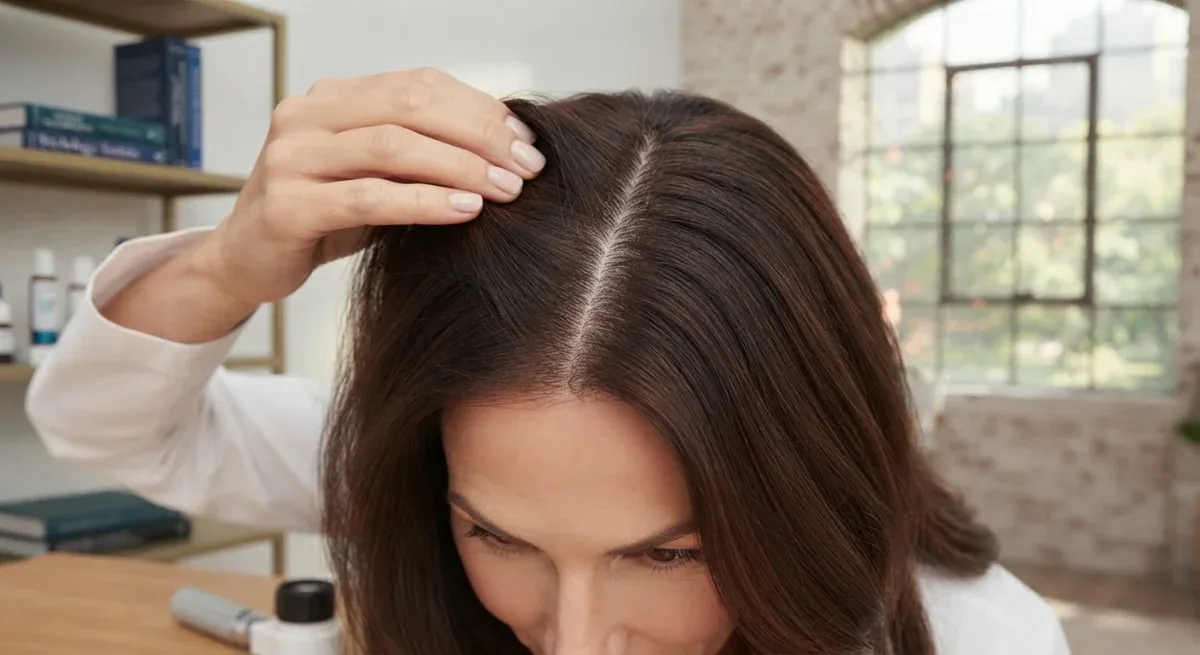
How the bacterial and fungal balance on your scalp shapes growth, flaking and irritation, and what actually restores it.
What Lives on Your Scalp?
A dense community of bacteria and fungi, dominated by Cutibacterium and Staphylococcus species alongside Malassezia yeast. In a balanced scalp they compete with each other and keep the skin barrier stable. The scalp also carries more sebaceous glands per square centimetre than almost anywhere else on the body, which makes it an unusually rich habitat.
What Causes Dandruff?
Not dryness. Dandruff is an inflammatory response to Malassezia overgrowth: the yeast metabolises sebum into fatty acids that irritate the skin, which sheds faster than normal and produces visible flakes. That is why moisturising a flaking scalp often makes it worse, you are feeding the organism causing the problem, and why antifungals such as ketoconazole and zinc pyrithione work where conditioners do not.
A flaking scalp is an ecology problem, not a hydration problem. Treat the imbalance and the flaking stops; treat the symptom and it returns in a fortnight.
Does Scalp Health Affect Hair Growth?
Yes, indirectly but measurably. Chronic inflammation around the follicle disrupts the growth cycle, pushing follicles into the shedding phase earlier and shortening the growing phase over time. Persistent itch and scratching add mechanical damage at the root. Resolving inflammation will not create new follicles, but it stops you losing ground on the ones you have.
How Do You Rebalance a Scalp?
- Exfoliate sparingly: a chemical exfoliant such as glycolic or salicylic acid once a week, not a scrub every wash
- Target the organism: antifungal shampoo left on for three to five minutes, twice weekly during a flare
- Do not over-wash: stripping sebum daily triggers rebound oil production
- Give it six weeks: the barrier and the microbial balance both take a full skin cycle to settle
When Should You See a Dermatologist?
If flaking is yellow and greasy, if the scalp is painful rather than itchy, if you see patches of hair loss with a defined edge, or if nothing changes after eight weeks of consistent treatment. Psoriasis, fungal infection and alopecia areata all present as scalp trouble and none of them responds to shampoo.
Keep reading: Top scalp care treatments · Scalp Care 101: The Foundation of Healthy Hair · Take the Hair Quiz.
Compare Scalp Care Products
Antifungals, exfoliants and balancing cleansers for flaking, oiliness and itch.
Questions
Frequently asked
01 What is the scalp microbiome?
The community of bacteria and fungi living on the scalp, dominated by Cutibacterium and Staphylococcus species alongside Malassezia yeast. In balance they compete with each other and keep the skin barrier stable.
02 Does washing hair less improve scalp health?
Only up to a point. Stripping sebum daily triggers rebound oil production, but leaving sebum to accumulate feeds Malassezia. Most scalps settle at every two to three days with a cleanser matched to that rhythm.
03 When is scalp flaking a medical problem?
When flakes are yellow and greasy, when the scalp is painful rather than itchy, when hair loss appears in patches with a defined edge, or when nothing changes after eight weeks of consistent treatment.
Sources & further reading
- Borda, L.J. & Wikramanayake, T.C., Seborrheic Dermatitis and Dandruff: A Comprehensive Review, Journal of Clinical and Investigative Dermatology, 2015.
- Grimalt, R., A Practical Guide to Scalp Disorders, Journal of Investigative Dermatology Symposium Proceedings, 2007.
- Brand INCI lists, Nizoral, The Ordinary and Pomélo+Co. declarations, retrieved September 2026.